The resultant of two forces has magnitude 20 N. One of the forces is of magnitude  N and makes an angle of 30º with the resultant. Then, the other force must be of magnitude -
 N
N
 N
N
Text Solution
Verified by ExpertsC
Quantities that possess magnitude as well as direction as known as vectors. They are represented in space by magnitude and direction.
Vectors can be added by different laws; one of them is the parallelogram law of addition. It states that when two vectors taken in different order such that they form the sides of a parallelogram, then their resultant is the diagonal between the sides.
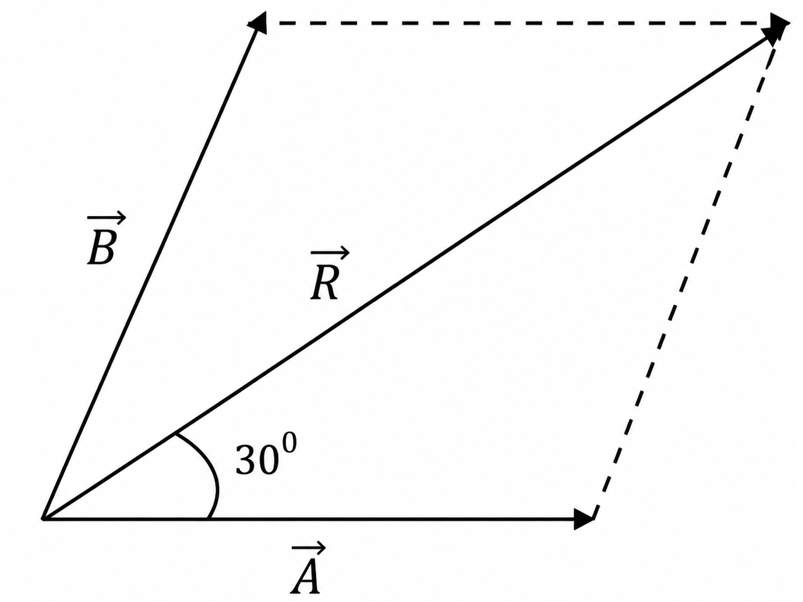
 is the resultant sum of
  and
and  . Therefore,


Squaring on both sides, we get,

Given,  , angle between
  is
is 
Substituting given values in the above equation, we get,





Therefore, the magnitude of  is 20 N.
Therefore, the force must be of magnitude 20 N.
Prepare Smarter with CGP Edu
Get practice questions, solutions, and test series in one place.
Write a Review
Share your experience with this question and solution.
Commentary
Send your comment, doubt, correction, or feedback to admin.
Similar Questions
Explore conceptually related problems